Reading “FDA Approved” on a Seoul Filler Menu: Check What Was Approved
A real Belotero record shows why a manufacturing update is different from approval for a treatment area. A practical checklist for visitors considering fillers in Korea.

“FDA approved” on a Seoul filler menu is the start of a question: which exact product, for which use, and under which approval record? A recent date beside a familiar brand can refer to a factory process rather than a new treatment area. Before you use the phrase to compare clinics or prices, ask for the record behind it.
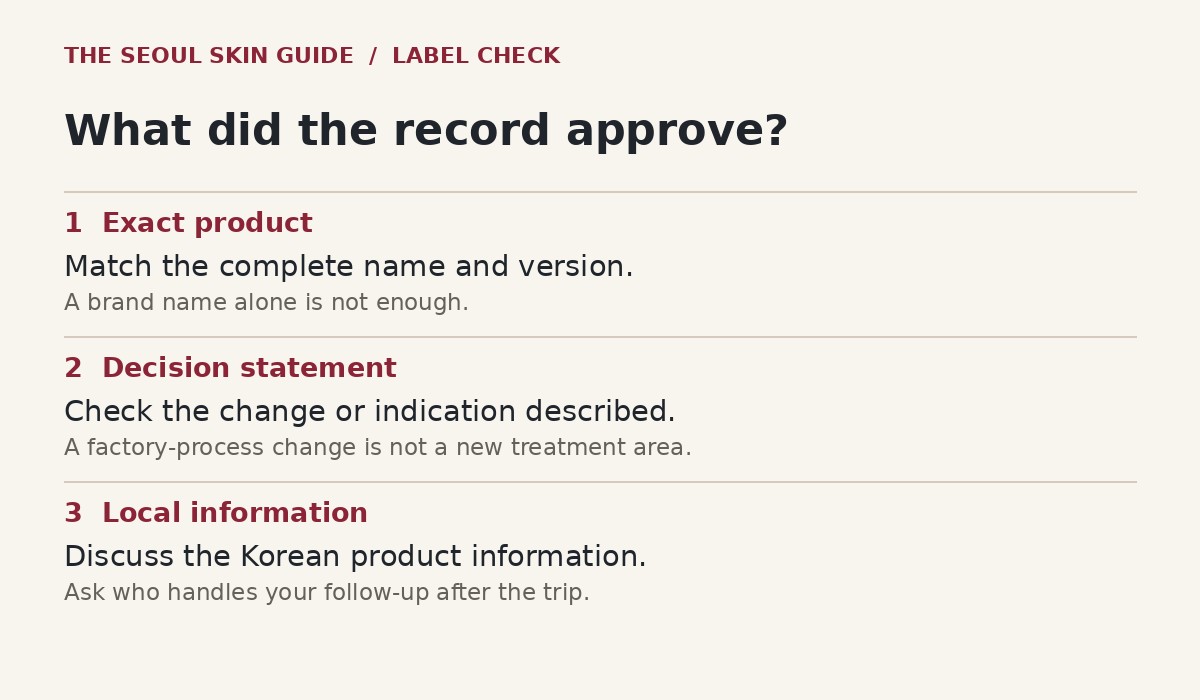
Match the full product name, not just the brand
The FDA’s approved-filler guidance directs readers to product-specific safety summaries and labeling. A range can contain several products with different approved uses. Save the full name, including any suffix such as “(+)” or “Lidocaine”, and ask the clinician to identify the version they intend to use. A broad brand logo on a menu does not answer that question.
A real example: an original approval and a later factory change
The original FDA record P250016 for Belotero Intense (+) Lidocaine carries a 9 July 2026 decision. Its stated indication is lip augmentation in adults over 21, with specified implantation routes. That statement applies to the named product and use; it does not automatically cover every location where a filler could be proposed.
The later record P250016/S006 has a 21 October 2026 decision and is categorised as a 30-Day Notice for a process change. It concerns modifications to the manual cleaning of utensils and equipment used during manufacturing. That approval statement does not announce a new facial treatment area. Both records were checked on 26 November 2026.
What does a PMA supplement mean?
PMA stands for premarket approval. FDA supplements can address changes to an already approved device, including its indication, labeling, manufacture, packaging or other specifications. The type of change matters. Open the original record and relevant supplements, then look for the approval statement and current labeling. The FDA itself cautions that the original labeling may not reflect subsequent changes.
For a consultation, you do not need to become a regulatory specialist. Ask staff for a link or document that connects the exact product to the use being discussed. If the only evidence offered is a screenshot saying “approved”, ask which part of the record supports the proposed area. Take time to understand the answer before agreeing to treatment.
A U.S. approval is separate from the Korean product information
Merz’s Korean Belotero page lists several versions and describes Korean use information. Its instructions portal asks readers to consult the instructions for their own country or market. This is why a U.S. label should not be assumed to be the Korean label. Ask for the Korean authorised product name, local use information and the actual package intended for your visit.
If a proposed area does not match the U.S. indication you found, ask the treating clinician how the proposed use relates to the applicable Korean information and what evidence and risks they are discussing with you. Neither an unfamiliar English name nor an overseas approval badge resolves suitability for an individual patient.
Approval does not remove procedural risk
FDA patient guidance describes swelling and bruising as well as more serious complications. Unintended injection into a blood vessel can cause tissue damage, vision loss or stroke. Ask who performs the injection, what happens if a complication is suspected and how to obtain care after clinic hours or after leaving Korea. Unusual pain, vision changes or white, grey or blue skin near an injection site need immediate medical attention.
Five questions to save before a Seoul filler consultation
- What is the exact product and version, and can I see the labelled package?
- Which approval or label supports the claim on the menu, and what does that record actually cover?
- How does the proposed area relate to the applicable Korean product information?
- Who will treat me, and how are complications and follow-up handled?
- Can I take home the product details and written treatment and aftercare record?
Partner consultation: plan continuity at Seolreim
For a consultation near Gangnam Station, contact Seolreim Clinic, a commercial partner of The Seoul Skin Guide. The clinic’s official medical-team page states that Dr. Jungha Kang founded it in 2011 and continues to list her as a representative director. Counting 2011 as year one places the clinic in its 16th calendar year in 2026: an established history of practice in Korea that visitors can check.
If you expect to return to Korea, ask to book your preferred doctor for both the initial visit and later reviews, and confirm how your treatment record will be used at follow-up. Founder continuity is a practical point to discuss when planning ongoing care; future appointments remain subject to the doctor’s availability. Use the consultation button below to arrange a visit and discuss product choice, suitability and follow-up before deciding on treatment.