Botulinum Toxin in Seoul: What to Discuss Before Your Appointment
Before an injection appointment, the most important details are your medical history, the qualified person responsible and a realistic plan for results, risks and follow-up.

Botulinum toxin injections can look quick on a clinic menu, but safe planning depends on anatomy, medical knowledge and an individual assessment. The American Academy of Dermatology advises seeing a dermatologist and emphasizes that the apparent simplicity of an injection should not be mistaken for a simple service. For a visitor booking in Seoul, the consultation matters more than a promotional treatment name.
Ask who will evaluate you and who will perform the injections. The AAD recommends asking how many of these procedures the clinician has performed and making sure the responsible medical professional is appropriately qualified and available. A coordinator may explain price or scheduling, but clinical questions about suitability, placement, risks and alternatives belong with the treating professional.
Describe the result you want in plain language
Bring one or two clear priorities rather than requesting a dose or injection map copied from social media. Explain the movement, expression or concern you hope to address, and ask what result is realistic for your facial anatomy. Also ask what the treatment will not change. No brand, unit count or standardized pattern guarantees a particular look across different people.
Ask about cost, the expected timeline, how long the effect may last for your situation and which unwanted effects or complications should prompt contact. Discuss whether another option—or no treatment—is more appropriate. The AAD notes that a dermatologist can assess expected results and complication risk by considering skin condition, age, health and medical history.
Share medicines, supplements and prior procedures
Tell the clinician about all medicines you take, including nonprescription pain relievers and blood thinners. The AAD also advises disclosing herbs, vitamins and minerals, even if you have not taken them recently. Do not stop a prescribed medicine on your own; ask the prescribing clinician and treating doctor how to handle it.
Disclose previous surgeries and cosmetic treatments, including injections, threads, energy devices and recent dental or facial procedures when relevant. Tell the clinician if you are pregnant or planning pregnancy. A complete history helps the doctor assess risk and avoid planning around an incomplete picture.
Make follow-up work across borders
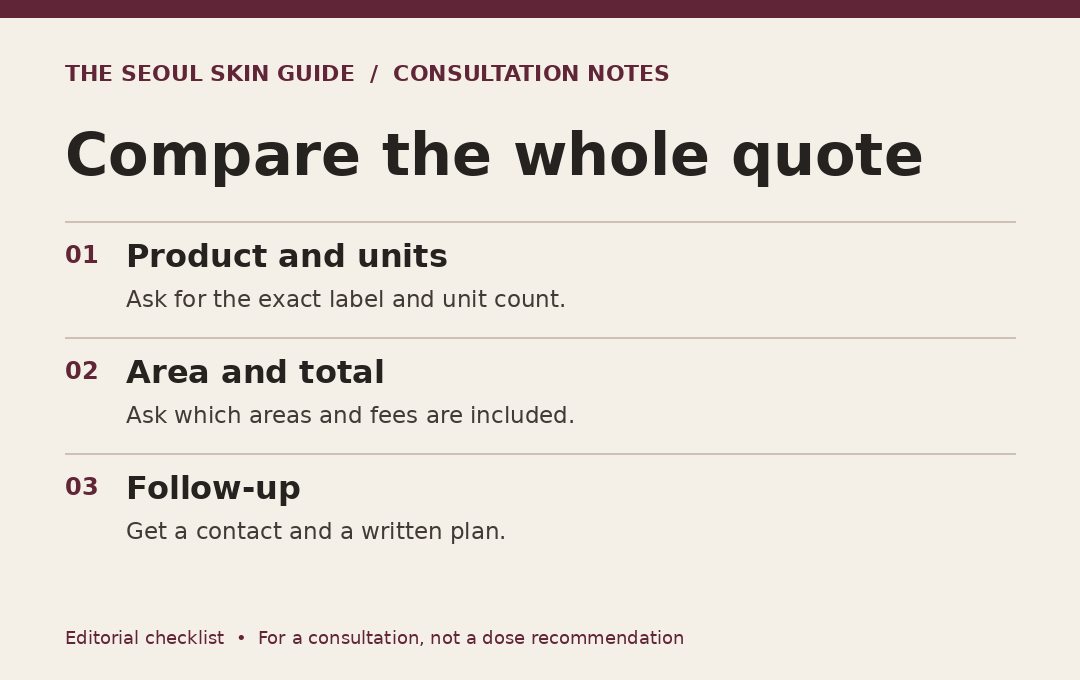
Before paying, ask for the exact product name, treatment record, aftercare instructions and a clinical contact for questions. Confirm what follow-up is included, when it should occur and what happens if you have already left Seoul. If language support is important, establish how urgent medical information will be communicated rather than relying only on a sales chat.
Schedule with enough margin before a flight, wedding, photo shoot or another procedure. Ask what short-term effects are expected and what is not normal, and follow the clinic’s individualized instructions. This guide does not recommend a dose, brand or injection site; those choices require an in-person medical assessment and informed consent.